
Report an error
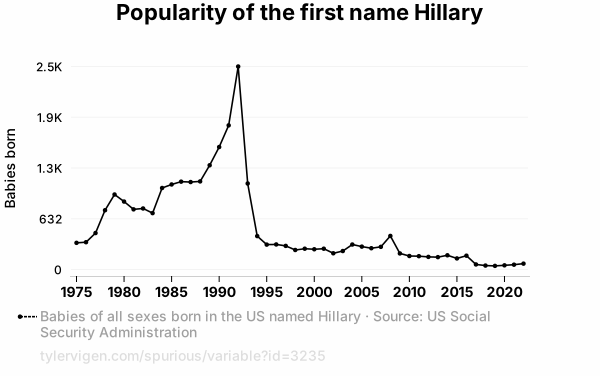
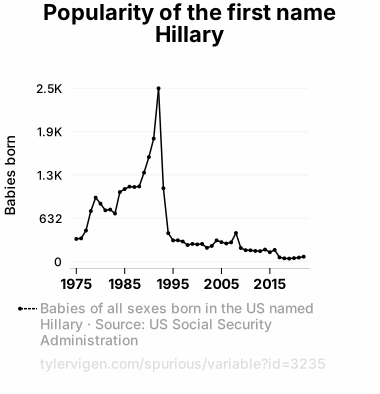
Popularity of the first name Hillary correlates with...
| Variable | Correlation | Years | Has img? |
| Popularity of the 'harambe' meme | r=0.98 | 7yrs | No |
| The number of tax examiners and collectors, and revenue agents in Oregon | r=0.96 | 13yrs | No |
| The number of dental laboratory technicians in New Jersey | r=0.95 | 20yrs | No |
| Kerosene used in French Polynesia | r=0.92 | 32yrs | No |
| Votes for Republican Senators in California | r=0.89 | 13yrs | No |
| The wind speed in San Diego | r=0.88 | 39yrs | No |
| Motor vehicle thefts in New York | r=0.88 | 38yrs | No |
| Evaporated and condensed milk consumption | r=0.87 | 32yrs | No |
| Jet fuel used in French Polynesia | r=0.87 | 42yrs | No |
Popularity of the first name Hillary also correlates with...
<< Back to discover a correlation
You caught me! While it would be intuitive to sort only by "correlation," I have a big, weird database. If I sort only by correlation, often all the top results are from some one or two very large datasets (like the weather or labor statistics), and it overwhelms the page.
I can't show you *all* the correlations, because my database would get too large and this page would take a very long time to load. Instead I opt to show you a subset, and I sort them by a magic system score. It starts with the correlation, but penalizes variables that repeat from the same dataset. (It also gives a bonus to variables I happen to find interesting.)